Article | Intelligent Investment
Business Insights | Living Sectors Unlocked: Insights from Renter Demand to Capital
From renter demand to capital deployment, Living Sectors Unlocked examined how Australia’s living sectors are performing in practice, drawing on real data, transactions and operating experience across CBRE’s platforms.
April 28, 2026
Download the Renters Report
Click Here
Australia’s housing challenge is no longer theoretical. Demand is clear, capital is active but more cautious, and delivery remains complex. Living Sectors Unlocked, hosted by CBRE brought together investors, bankers, fund managers and government stakeholders to share first hand insight into how the Living sectors are actually performing, and how assumptions are evolving in real time.
Living Sectors Unlocked was designed to provide decision makers with direct access to data, transactions and operating experience drawn from across CBRE’s living, research, capital markets, debt and valuation platforms.
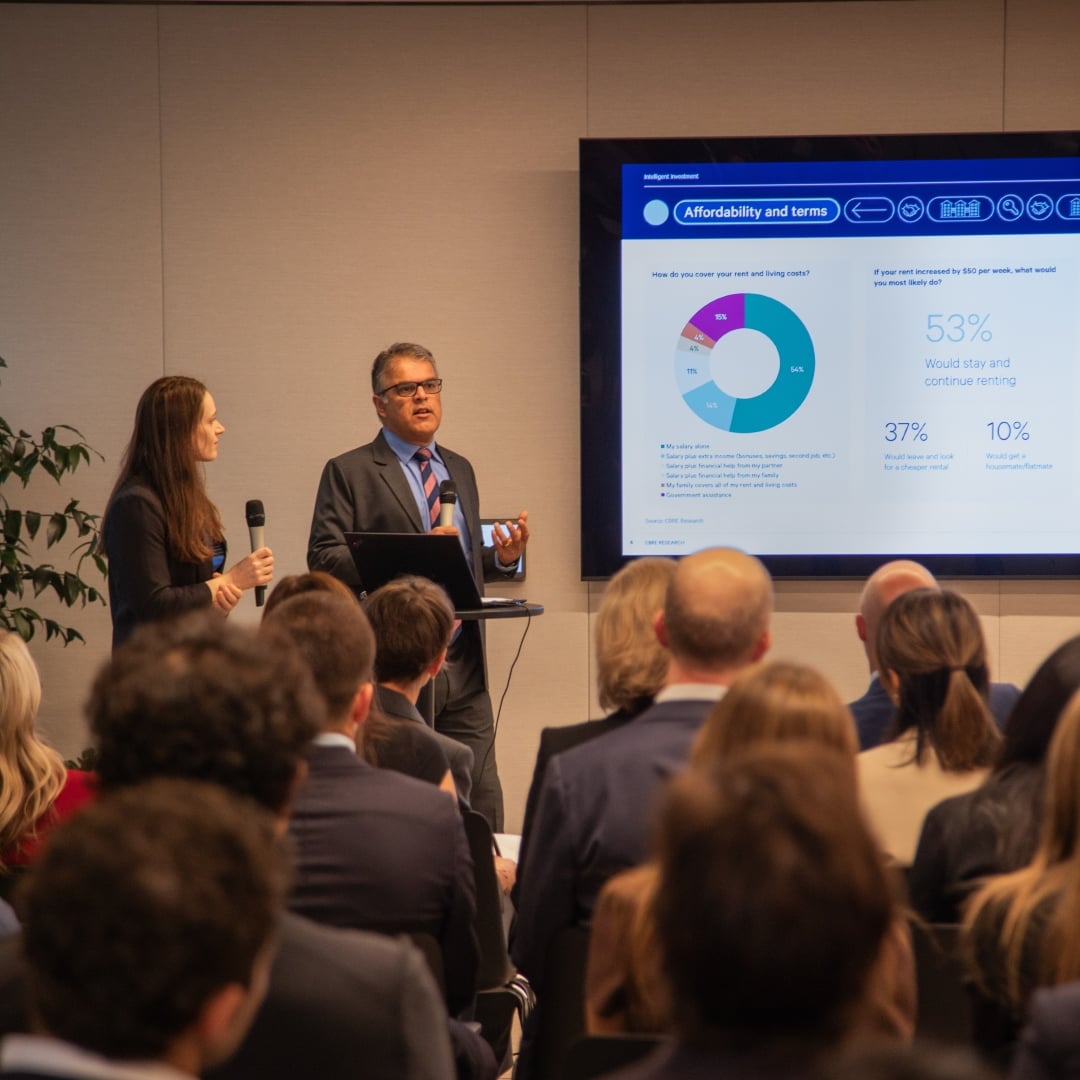
Attendees heard from Andrew McCasker, Managing Director Debt & Structured Finance, Capital Markets; Alex Shaw, Director Living Sectors Capital Markets; Steph Harper, National Director of Living Sectors, Valuations & Advisory Services, and Sameer Chopra, Head of Research at CBRE, alongside Anne Flaherty, Senior Economist at REA Group.
Living Sectors Unlocked was designed to provide decision makers with direct access to data, transactions and operating experience drawn from across CBRE’s living, research, capital markets, debt and valuation platforms.
Attendees heard from Andrew McCasker, Managing Director Debt & Structured Finance, Capital Markets; Alex Shaw, Director Living Sectors Capital Markets; Steph Harper, National Director of Living Sectors, Valuations & Advisory Services, and Sameer Chopra, Head of Research at CBRE, alongside Anne Flaherty, Senior Economist at REA Group.
There are no single solutions at this stage of the cycle. What Living Sectors Unlocked demonstrated, however, is that the quality of evidence is improving. With deeper operational datasets, clearer renter insight and more active capital dialogue, the market is better placed to test ideas, challenge conventions and distinguish signal from noise. CBRE’s role was not to offer definitive answers, but to bring informed perspectives together and examine what is holding, what is shifting and where the next constraints may emerge.
At the same time, affordability pressure is reshaping behaviour. Rents have increased by more than 50 per cent nationally over five years, vacancy rates remain historically low, and share housing is increasingly a necessity rather than a choice, particularly among older cohorts. For investors, the implication is clear. Renter insight is no longer a marketing consideration. It is a core input into underwriting, design and long term asset performance.
Private credit continues to play a meaningful role, particularly in de risking development pathways, while domestic banks have become more constructive as performance evidence has expanded. Offshore capital remains active, although policy settings, including overseas surcharges, continue to influence deployment decisions.
A consistent message from the panel was the risk of over generalisation. Living sectors are not a single asset class, and each project is demonstrating its own performance profile. That divergence is shaping investment decisions and increasing the emphasis on evidence at this point in the cycle.
Living sectors continue to evolve, and the debate remains essential. CBRE will continue to convene expertise, challenge assumptions and support clients as the sector moves into its next phase.
The renter reality: clearer, sharper and more demanding
Exclusive research from CBRE and REA Group reinforced that renter demand is far from uniform and should not be underwritten as such. Australia’s renter base spans income brackets, life stages and geographies, with around a third earning above $105,000 and a third below $50,000. What unites them is a focus on fundamentals. Location and price dominate decision making, supported by essentials such as security, parking and pet friendliness.At the same time, affordability pressure is reshaping behaviour. Rents have increased by more than 50 per cent nationally over five years, vacancy rates remain historically low, and share housing is increasingly a necessity rather than a choice, particularly among older cohorts. For investors, the implication is clear. Renter insight is no longer a marketing consideration. It is a core input into underwriting, design and long term asset performance.
Capital is available, but far more selective
Panellists agreed that Living sectors continue to attract capital, though expectations have tightened. Structure, scale, partner capability and downside protection now carry greater weight than narrative. Disciplined underwriting is replacing thematic optimism, with asset specific risk and early operating data increasingly central to bankability.Private credit continues to play a meaningful role, particularly in de risking development pathways, while domestic banks have become more constructive as performance evidence has expanded. Offshore capital remains active, although policy settings, including overseas surcharges, continue to influence deployment decisions.
Performance and valuation are converging
As more Living assets transition from delivery into operation, performance differences are becoming clearer. Occupancy, tenant retention and expense management, rather than headline rents alone, are emerging as the primary drivers of value. Valuation approaches are becoming more granular, reflecting operator capability, amenity decisions and local conditions rather than broad sector assumptions.A consistent message from the panel was the risk of over generalisation. Living sectors are not a single asset class, and each project is demonstrating its own performance profile. That divergence is shaping investment decisions and increasing the emphasis on evidence at this point in the cycle.
Why bringing disciplines together matters
If one point resonated throughout the morning, it is that housing outcomes improve when data, capital, policy and delivery are assessed together rather than in isolation. Forums like Living Sectors Unlocked help create a shared understanding of the facts on the ground, enabling more informed decisions across government and capital.Living sectors continue to evolve, and the debate remains essential. CBRE will continue to convene expertise, challenge assumptions and support clients as the sector moves into its next phase.
Get in Touch
Duncan Guthrie
Executive Managing Director, Valuation & Advisory Services, Pacific

Steph Harper
National Director, Living Sectors, Valuation & Advisory Services, Australia

Andrew McCasker
Head of Debt & Structured Finance – Capital Markets, Pacific

Alex Shaw
Director, Living Sectors - Capital Markets, Pacific

