Kathryn House
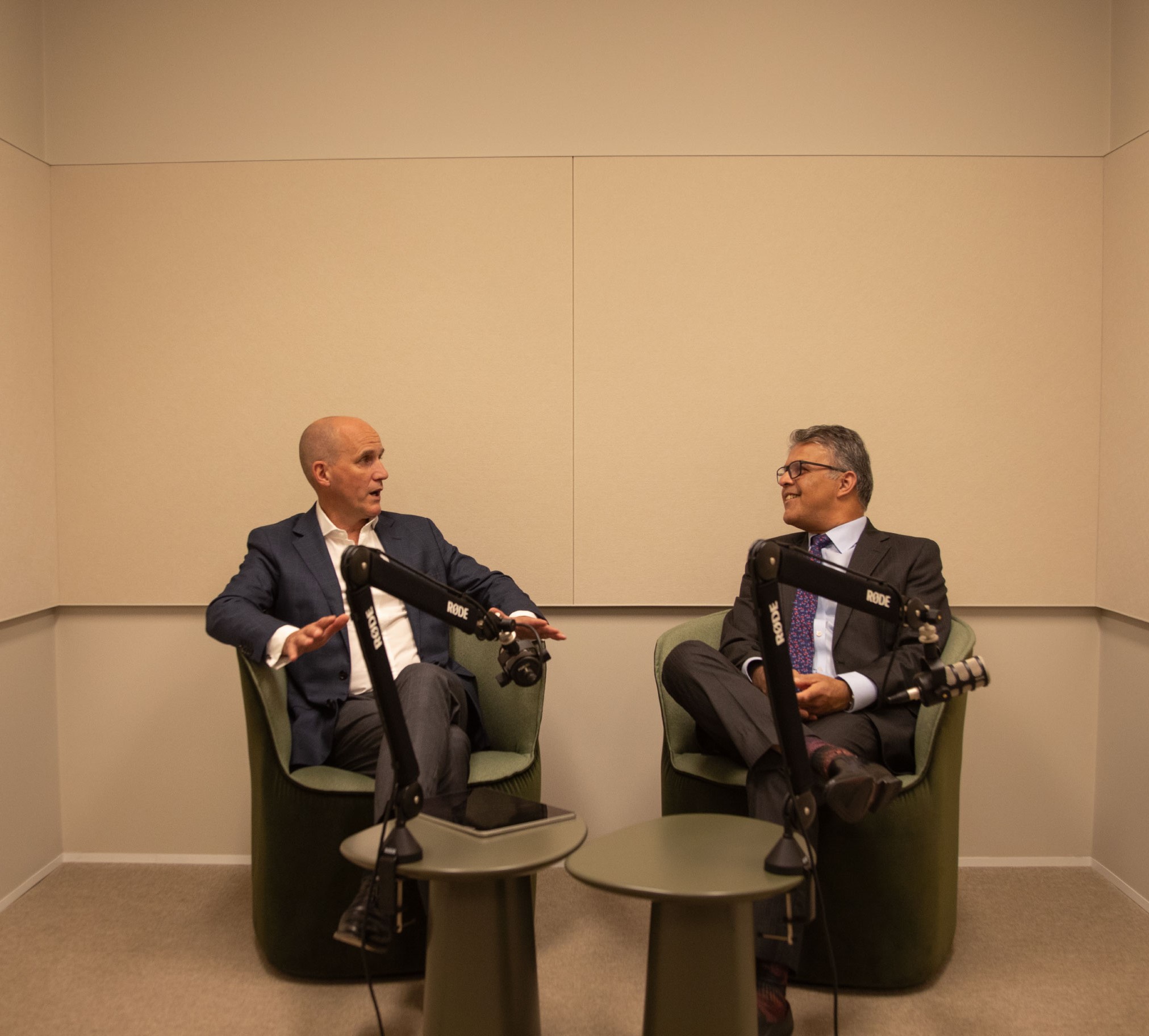
Hello and welcome to our quarterly Talking Property series, The House View. Together, CBRE's Australia and New Zealand CEO Phil Rowland and Head of Research Sameer Chopra investigate what's next for the Australian property sector, the potential disruptors, emerging opportunities and what's top of mind for the industry's major players. We hope you enjoy their conversation.
Phil Rowland
Hello, I'm Phil Rowland and it is great to be back with CBRE's Head of Research, Sameer Chopra for our final edition of The House View for 2025. In this episode, we'll be exploring how Australia's real estate market is positioned leading into 2026, what we're seeing across international markets, and why we can't afford to be complacent about inbound capital flows as attractive competing opportunities emerge in other markets like the US and Japan. We'll also examine what we're seeing in the debt and equity markets, the latest occupier and workspace trends, and the evolving role of AI in the property sector. And be sure to stick with us till the end when we'll look back at our predictions from the start of the year to put some scores on the door. So, Sameer, let's kick it off. Let's look at the macro picture. We've been through a very challenging and painful period in the sector. What's the macro picture now telling us?
Sameer Chopra
Phil, yeah, look, real estate appears to have climbed this massive wall of worry over the past three years where there was higher interest rates, there was questions around the return to office rates, the impact of e-commerce on shopping centres, the mortgage cliff on residential, the impact of tariffs, step up in land taxes, jump in construction costs. Geez, you know, a lot's been thrown at the sector and it has withstood the onslaught. Capital values have remained at or near 2022 levels in residential, in logistics and retail. Vacancy is still very tight in logistics at just 2.5%. Vacancy is just 1.8% in residential. And if you look at large format retail and convenience, retail rents are ahead of where they were at pre-Covid level. Kind of goes back to that point. Phil, you made a couple of episodes ago just about being resilient.
Phil Rowland
Yeah, yeah, that's quite the contrast you painted there Sameer. And look, presumably a number of these headwinds have now become tailwinds or at least less of a drag on the sector's ability to transact and grow. And you could argue that this is what makes Australian real estate so appealing in a global context. We've talked a lot about strong population growth, which is driving solid, long-term demand across office, logistics, retail, housing and the infrastructure investment that's supporting the backbone of development. This includes $100 billion per year that's been spent or allocated to city shaping infrastructure. You know, air transport projects like Western Sydney Airport, road projects like Melbourne's Westgate Tunnel and Adelaide's North South Connector, and rail in the form of Sydney Metro and Brisbane's Cross River Rail. This is a really important tailwind for development.
Sameer Chopra
Yeah, look at the same time you've got this low vacancy across industrial, residential and retail. Plus we're still very early in the rate cutting cycle. We know. I keep harping on about the outlook for low rates, but I'm still expecting, Phil, that there could be another five rate cuts to go from here.
Phil Rowland
Well, let's hope so. Plus there's a scope for a more active tilt into real estate from the superannuation savings system which now totals over $50 trillion. So potentially a good setup going into 2026. So what are we seeing globally, Sameer? Why don't you walk through some of the global market trends.
Sameer Chopra
Yeah. Let me start off with the US. CBRE asked US investors which sector will perform the best in the coming 10 years. It's always an interesting question. We get asked about this a lot in Australia all the time. And you know, the US respondents are now most optimistic about the multifamily sector, just ahead of industrial. Retail is in third place, followed by hotels and then office ranks last.
Phil Rowland
Yeah. And on the outlook for pricing, our US cap rate survey also found that the all property cap rate estimate declined slightly, falling nine basis points. So this may be a sign that we're past the peak of cap rates despite the ongoing sort of macroeconomic uncertainty and entering a new period of property yield compression.
Sameer Chopra
Yeah, so you know, cap rates are starting to stabilise and maybe even compressing in the US market. What's really interesting, Phil, is that the average spread between what people are expecting on their lower and upper estimate, it still widens a little bit in office, but that same spread is now tightening in retail. So put it another way, investors are gaining conviction around how to price retail assets, but there's still a little bit of debate about office values. And just sticking on retail Phil, you know, this is sector du jour. Its share of the global investment volumes has increased by 1.2% quarter-on-quarter. It now makes up 17% of all commercial real estate transactions since it's bottomed out in 2021. And it's continued to gain share. Just on that, by the way, logistics has seen a 10 percentage point share gain in terms of investment volumes over the past decade and it's become a proper institutionalised market.
Phil Rowland
And just on leasing velocity, there are some clear signs. Let's look at the Manhattan office market for a minute. It's really bounced back. Leasing activity in August was up 63% ahead of the five-yearly monthly average. Vacancy including sublease is down 2.5% year-over-year. And it's not just Manhattan. Office trends have been strong in Tokyo as well. Our team covering Tokyo office noted that vacancy is around 2.5% and rent growth for grade A increased 2.7% quarter on quarter. So arguably some of the fundamentals emerging for office in a number of global markets.
Sameer Chopra
Yep, yeah, look, office looks good and then just sort of moving to logistics. The main observation globally is just around supply restrictions. Both the US and Europe, Phil, have seen completions now drop to levels we last saw in 2017. So it's not just Australia, but globally supply has declined materially, say by 30 to 40% from the peaks seen in 2022. Actually last week a client was telling me on their numbers, supply is down 50% from peak levels. My point here, Phil, would be that whilst Australia screens well on a macroeconomic picture, strong population growth, like you said, low levels of debt in real estate, there are a number of global markets where some of the rent and cap rate dynamics might mean that there is a plethora of attractive opportunities. And so, you know, in Australia we just need to make sure we don't become complacent on inbound capital flows. I think this is a point I'd make more to government. It's likely to be a very competitive global capital allocation environment.
Phil Rowland
Yes, yeah, undoubtedly. You know, on the equity side, I was speaking with Stu McCann, head of Capital Advisory in Australia and you know, his feedback is we're certainly seeing larger capital partnerships being formed as investor confidence returns and landlords look to establish strategic capital partnerships here in Australia. Now, the development pipelines of our major listed players and large developers, they are significant and it's making it essential to bring in long-term, strategically aligned capital partners. And of course this is resulting in a lot of capital partnering activity as many of the Australian players move to this capital light, co-investment model and Australia does screen well. The market offers capital and income growth. Cap rates remain elevated, and to your point, high on a relative basis, particularly versus mature Asian markets such as Singapore and Japan. And supply across all sectors is reduced, so driving positive rental growth. This is giving confidence to big LPs to deploy into these dynamics. PSP's investment into Aliro's industrial development venture is a great example of that. This is a very large allocation in any market.
Sameer Chopra
Phil, just on that, speaking to the other side of the capital stack, I was chatting with Andrew McCasker about what we're seeing in credit and he makes the point that while base rates continue to drop slowly in line with the RBA's cash rate, there is now more competition for debt transactions, particularly amongst the domestic banks. And in turn this is resulting in banks driving risk margins to levels we've not seen since pre-GFC. And these low margins are now coupled with the domestic banks reducing condition precedents. So by way of example, let's say you've got a build to sell residential project. In some instances, borrowers can now seek debt while being below 50% pre-sold. We're also seeing higher loan amounts being structured off "as if complete" valuations. It's definitely a race for market share and I think borrowers are winners.
Phil Rowland
So Sameer, let's dive into what we're seeing on the occupier front. Our leasing teams have just polled occupiers in logistics and office, and in that survey our feedback from occupiers has been that small companies are achieving attendance expectations while larger organisations are not. And just over half of the occupiers expect continued improvement in attendance rates in the future. So this theme of stabilising office attendance still has some room to play out. The survey also found that nearly two-thirds of respondents expect to expand their footprint over the next three years and fewer are contemplating contraction. And then lastly, and not surprising, location is paramount for office tenants, particularly those seeking to renew their leases, with 83% of respondents prioritising it.
Sameer Chopra
And of course Phil, just on improved amenity and services are essential when you start to consider relocation. We've also been looking into the economics of office rents from an occupier lens and our analysis suggests that banks and insurers typically spend around 0.7% of their revenue on rent. Investment banks and wealth managers spend around 2.3% of their revenue on rent. And for professional services firms, that's about 4.6%. So what I'm saying here Phil, is that for every $100 of revenue, say a law firm or an accounting firm generates, about four and a half dollars goes towards rent. So it's an important cost line, but it's not a major impact on margins or profitability.
Phil Rowland
Sameer, let's shift to logistics. Our logistics occupier survey highlighted the cost pressures that occupiers are trying to navigate. Rising freight, labour, land costs are all triggering portfolio reassessments and rent sensitive decisions. In fact, a large number, 71% of respondents, called out transportation and labour as their top cost concerns.
Sameer Chopra
Yeah, Phil, I agree, right. Transport, fuel costs, labour, and that just needs to be sort of weighed up against the majority of occupiers in Australia who are at the same time expecting to increase their logistics footprint over the medium term. So you're trying to balance this kind of unit cost pressure with a need for more space. And most of the expansion decisions favour leasing modern facilities. Particularly, a lot of these occupiers also have one eye on meeting their sustainability commitments.
Phil Rowland
Yeah, yeah. And occupiers are looking to expand within their established city networks, not necessarily through market entry. The research team also benchmarks occupancy costs for logistics. I know this work that you and your team have done, Sameer, and this is the warehouse rent compared to revenues. So your team found that the ratio is nearly 6% for 3PLs and about 0.3% for grocery and pharmaceuticals. So this would suggest that where you're located to optimise driver time, fuel cost and cost of tolls are perhaps more important than actual warehouse rent.
Sameer Chopra
Yep. Also, Phil, the other big thematic in logistics is the role that robotics will play in industrial design. Two-thirds of occupiers are looking for greater clearance heights and wider column spacing just so they can support this level of automation. Just on that, I was listening to a podcast on Optimus. This is this next generation of robots which are powered by AI. They look a lot like humans. They've got this hand dexterity, they've got really good forearm and leg movement. And at least, you know, the initial expectation is that these things will be built at scale and they'll cost about sort of 40 to $50,000 per robot. And, you know, you get this huge uplift in productivity. You can run these robots 24/7. And I think they'll start to play a role in warehouse operations towards the end of the decade. Just something for us to think about, you know, as clients come up for lease negotiations.
Phil Rowland
Very interesting. And more broadly, most occupiers, landlords and service providers have been developing their strategies for AI. So we were discussing this the other day at our last exco meeting with a professional services firm who has actively rolled out AI across their entire global operations. Quite staggering numbers across their global business. $1 billion invested into AI and about 2000 people currently employed via AI, 50 of which are in Australia. So that just tells you about the magnitude of how much they are embracing it. So let's break down the role of AI that could play into it for Australian occupiers and landlords, both in terms of driving productivity, but also providing unique revenue opportunities. I know in Australia the financial services and professional service sectors have really been at the forefront of bracing AI.
Sameer Chopra
Yeah, look, the question we field, Phil, is, you know, whether it'll have a material impact on footprint, how much, when, where keeps coming up. And to start the analysis, you know, it's probably worth looking back at history. There's been this enormous development in technology. And you know, let's look at how this has so far impacted headcount. So maybe, you know, Phil, I'll take you back. There was 730,000 Australians working in finance and professional services back in 1990. And since then we've had internet and mobile banking tools like Salesforce, Zoom Teams, Google Docs, Microsoft, really good specialist technologies, Ansarada, Clio, LEAP, Xero, Canva. All of this is kind of meaningfully transformed work, what we do and how we do it at a really fast pace. And I'd say a large number of roles in these sectors have also been outsourced to India and the Philippines as part of business process outsourcing. So it's kind of interesting to learn that there are now nearly 1.8 million people working in financial services and professional services today. So 730,000 back in 1990 has become 1.8 million jobs in 2025. AI will have an impact, no doubt, but it'll also allow us to sort of move forward in a more productive manner. Jobs and skills will evolve, but at this stage I'm not expecting a material shift in real estate requirements. I think the thing I'd be probably most interested in is it'll create a lot of good opportunities for flex operators.
Phil Rowland
And we come into this environment when future supply is already being curbed. We've cut our expectations of future supply in office by 45%, shopping centres by 29%, logistics by 25% and apartments by 11%. And most of these cuts, Sameer, are because of the economic rent issue. But it might prove to be a helpful backstop for the real estate industry trying to navigate this structural uncertainty. So, Sameer, let's switch gears for a second. Let's spend some time on residential. The market seems to be showing some signs of picking up after the recent interest rate cuts and auction clearance rates have settled in over the 70% range. So how might this play out over the next few quarters?
Sameer Chopra
It's still a very tight market out there, Phil. We expect capital city vacancy will fall further. It could drop as low as 1.1% by 2030. It's about 1.8% right now. And our bottom up estimates are that the future supply of apartments will hover around the 60,000 per annum level for the next four years. And the way population is growing right now, the demand side is 75,000 per annum to avoid this further fall in vacancy. So 60,000 supply, demand at 75,000.
Phil Rowland
And you've also forecast that rents are likely to be stable over the short term, so over the next 12 to 18 months, before they pick up to drive a 20 to 25% increase towards the end of the decade. Now, surely wage growth is not going to be at the same kind of level. So are you not worried about affordability? Can the market really sustain this level of rental growth?
Sameer Chopra
Well, what we did here is we did our own proprietary analysis. It shows that there are large segments of the market which can sustain that type of rent growth, rent level and rent growth. Professions, where you are on your career journey, matters a lot, and the extent to which there are multiple earners in the household all kind of factor into the segmentation. So we're comfortable that rents can be sustained. I'm keeping an eye actually on the growth in youth unemployment as this could make things challenging in the short term.
Phil Rowland
Yeah, okay, look, why don't we do a quick walk through what's topical or any sort of interesting snippets across each of the sectors. Perhaps some fun facts as we close out 25. I was on an industry panel recently and there was a lot of interest in the data centre and living sectors. As you and I both know, Sameer, massive growth opportunities in each, and investment teams are looking at ways to get access to the right opportunities. Now, there are still some planning challenges in these sectors, but the sentiment in the room was strong. But importantly, a recognition of the benefits of partnering with firms who have already built scale and have strong track record and specialist expertise.
Sameer Chopra
Talking about sentiment, Phil, there's also a lot of talk about firms looking to cut back on graduate hiring. A lot of clients and people asking, you know, if these headlines are all about AI. And just to share a snippet, I met a large professional services firm, a law firm, that is maintaining their graduate hiring for 2026. And the partner there said, you know, at the same time, what they really want to do is make sure they have a pipeline of future talents. So there's headlines, but I think firms right now are kind of sticking by creating future talent.
Phil Rowland
Yeah, it's important. Well, sticking with the theme of productivity, one of the biggest bugbears for retail occupiers is lack of trading after 5 o'clock. So we're hearing of more shopping centres experimenting with adding gyms and evening dining options to drive traffic after hours. Just on shopping centres, it does look like we're now starting to see a lot of momentum on the development of mixed-use. You know, through the A-REIT reporting season, I highlighted a building pipeline of apartments on shopping centre sites, particularly in Sydney. I think it's almost 8,000 new apartments planned on shopping centres.
Sameer Chopra
A big number. 8,000 apartments. Yeah, look Phil, I was also doing some work on what are the most desirable features in apartments. And you're going to laugh at this one. But the number one feature during purchase and rent decision is access to an internal laundry. And this is typically followed by car parking as the number two feature. So amenities and security are important, but nothing beats the humble internal laundry and having a car park.
Phil Rowland
There you go. Basics. And sticking with residential, a fundamental call to action is to provide new product to the market, and that is that the average age of an Australian first home buyer has increased from 26 years to 36 years. Lots of contributors to that. But, you know, things like student debt and the delays in family formation. And the interesting thing too here, Sameer, is just the pure headroom for institutional ownership in Australia to meet this need is big. Institutional ownership of rental housing in Australia is one in 1,000 household. Contrast that with the UK, which is at one in 100 and the US at in 10. So, you know, you've got scope for institutional ownership and residential to be tenfold.
Sameer Chopra
Some of the renters in these households are international students. And, you know, just on students, we actually went out and met a number of international students across Sydney, Melbourne and Brisbane recently. Their number one feedback for choosing Australia was culture. University rankings also matter. But culture, proximity to Asia, being close to friends and relatives, these are the big sort of drivers of why students come to Australia.
Phil Rowland
Yeah. And, and there is really good levels of pastoral care in the PBSA sector in Australia. Sameer, I asked one of the leading AI models the other day what the rent growth for offices in Perth might be for 2026 and it suggested 5.5%. Now that does seem a reasonable forecast. Look out, Sameer. The forecaster is getting as good as yours.
Sameer Chopra
Phil, I'm just hoping it's getting trained on our data and if it is, then for sure we'll get some interesting insights. Who knows? All the responses could start to reflect my usual bullishness. I also asked, by the way, Phil, one of the AI models, which suburb will have the fastest apartment price growth in 2026 and it suggested, drum roll, inner Perth and inner suburbs of Sydney and Melbourne. I'm going to take a slightly contra view here and say it's going to be the outer suburbs that outperform the inner ring. And the reason for that is, you know, these outer suburbs are, you know, they just have better leverage when you've got falling interest rates and we've got this rising wages in this care sector economy.
Phil Rowland
Sameer, you were in the Gold coast recently for an Olympics-related event. Did you pick anything interesting up there?
Sameer Chopra
Firstly, I'm not participating in the Olympics, Phil, but I'd say, Phil, just a lot of people are working really hard to make this happen. But I was just blown away by just the acute shortage of industrial space. There's going to be massive demand from the construction material sector. But even simple things for like, a place to store all the stuff you need on the day of the Games, like traffic controllers, pedestrian barriers. Vacancy in that Southeast Queensland market is just so tight and it's unlikely that the warehouse and storage sector can respond. So you know, there'll be some really interesting, really interesting opportunities for industrial owners.
Phil Rowland
All right, well there's some good snippets there. Alright, so let's get through this last section here, Sameer. Let's look at the scores on the door. So how did we fare on our predictions from the beginning of the year? The first prediction was on the pace of interest rate cuts, if I recall correctly.
Sameer Chopra
Yeah, Phil, we've cycled past three cuts this year, which was baked into our forecast. I'm still optimistic that our bull case of eight cuts through the cycle eventuates.
Phil Rowland
All right, prediction number two was for 10 to 25 bps of cap rate compression by the end of 25 for exceptional real estate. So this was for premium office in Sydney and Brisbane and regional shopping centres and select PBSA.
Sameer Chopra
Cap rates, you know, they've definitely stabilised during 2025, I'd say, you know, premium office towers are showing signs of compression. It's probably closer to 10bps, Phil, rather than 25bps. This is towards the end of Q3. We're also seeing around 10bps of cap rate compression for a number of retail assets. Recall, Phil, you know that retail cap rates had held up well during the cycle and there are signs that, you know, student accommodation and logistics assets are kind of really well bid.
Phil Rowland
All right. Third one to watch would be whether we get an improvement in leasing velocity in the second half of 2025 as we cycle past interest rate cuts, federal election. And you couple that with a case of pent up demand and a bit of FOMO around future supply.
Sameer Chopra
Yeah. And you know, incentives are still high and so fingers crossed, we were hoping that leasing volumes pick back up, particularly in the last quarter. You know, it hasn't been an amazing year in terms of leasing, particularly in office, but let's see how the last quarter plays out.
Phil Rowland
Righto. So my fourth prediction was that there was a lot more pressure for five days return to office in some sectors, particularly financial services and government. So this is probably more related to social equity across the workforce.
Sameer Chopra
Phil, I think the data is it's still suggesting that there's some increase in office visitation, particularly Mondays have started to pick up, but there's still meaningful variance between some segments and in cities.
Phil Rowland
Yep. All right. Well, I think that wraps us up. Thank you, Sameer, and thank you to our listeners. I hope you enjoyed this latest edition of The House View. You can always send us your feedback and any questions you might have via
[email protected]. We'll be back with The House View in the first quarter of next year, so make sure to subscribe to Talking Property so you don't miss this or any of our fortnightly Talking Property episodes. Until next time.