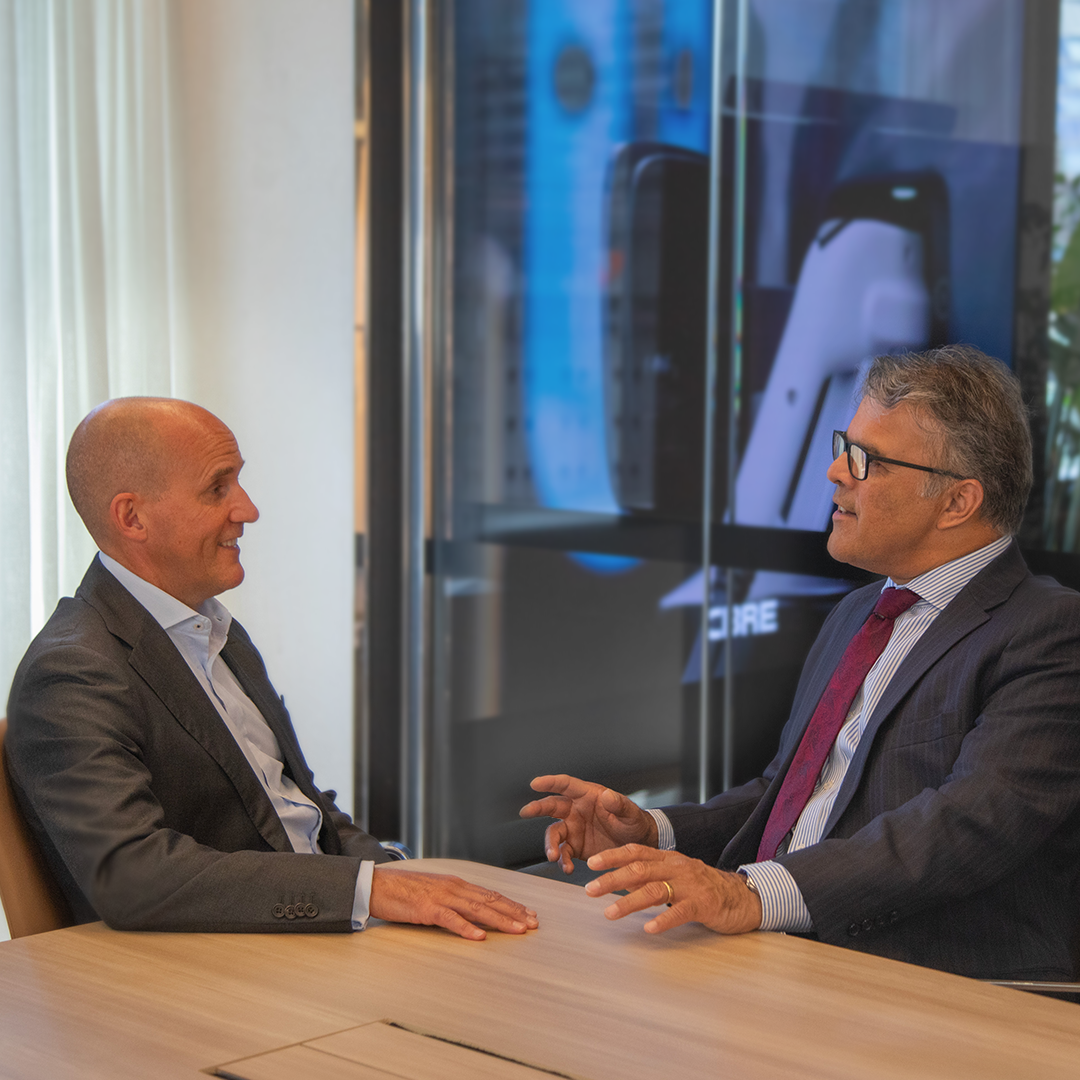
Hello, and welcome to our quarterly Talking Property series, The House View. Together, CBRE's Australia and New Zealand CEO, Phil Rowland, and Head of Research, Sameer Chopra, investigate what's next for the Australian property sector, the potential disruptors, emerging opportunities, and what's top of mind for the industry's major players. We hope you enjoy their conversation.
Phil Rowland
Hello. I'm Phil Rowland, and it is great to be back with Sameer Chopra for our first edition of the House View for 2026. In this episode, we'll be exploring our outlook for the year ahead. Sameer and his team have just published our 2026 Market Outlook, which has very interesting themes for the Australian property market. The most notable being this era of constrained supply, something Sameer has identified as Tina - There Is No Alternative. So we'll get him to explain an acronym for us and discuss its expected impact on rental growth, and returns. We'll also take a look at what's on the horizon for the various asset classes, contrasting Australia with other global markets. And be sure to stick around until the end of the podcast to hear our predictions for the year ahead, including why developers should be building now. Before we dive into it, Sameer, you traveled to India over the break to visit family. The India economy is on a real tear at the moment. What did you pick up while you were there?
Sameer Chopra
Yeah. Phil, India's definitely on a tear. A lot of infrastructure investment going on in India. Office rents, particularly in markets like BKC, are up sort of twenty percent plus. There's this vibrancy about India, but, the kids really enjoyed catching up with their grandparents. In India, that was definitely an experience.
Phil Rowland
That's the most important part.
Sameer Chopra
Yeah. That's right. And, look, on a personal level, Phil, as you know, you know, November, December last year, I took up Pilates. Yeah. So I've kinda continued to do that. It's a real sort of focus on, kinda build my core strength.
Phil Rowland
There you go. Oh, well, I'm sure you'll be in zen mode.
Sameer Chopra
Yep.
Phil Rowland
Right. Well, let's get down to business. Let's start with what we see on the horizon as we kick off the year. Our global teams have produced a range of country and region wide 2026 outlooks. It's fair to say that despite all these prevailing geopolitical tensions, sentiments positive and there's a real sense that we're entering a new cycle in commercial property. We're seeing some common themes across countries such as a recovery in transaction volumes, the scarcity of new supply, which I'm sure we'll get into, and the ongoing outperformance of premium properties, particularly in the office sector. Sameer, let's start with investment volumes. What are we expecting?
Sameer Chopra
Yeah. Phil, look, last year ended well. And, just looking at transaction activity, we're expecting five to 10% growth for Australia and New Zealand, this year. Our colleagues in the US are looking for about 16% growth. But I think, you know, like, we've just seen some good conviction coming back around asset pricing now. Last year, we saw 10 to 20 bps of cap rate compression in shopping centres, about 20 bps of tightening in Sydney industrial. So, you know, you can sort of start buying or selling with some level of conviction now that prices are stable.
Phil Rowland
Yeah. You can certainly see that. And I think the swing factors between an okay and a great year will boil down to a couple of factors. You know, firstly, if we have a period of broadly stable interest rates and, you know, we'll see what, transpires there. And secondly, investor interest is broadening outside of Sydney and Brisbane to encompass Adelaide, Melbourne, and Perth.
Sameer Chopra
Yeah. Phil, and, you know, outside of just transactions, you know, leasing itself, we're expecting mid-single digit type volume growth. Our expectation is that larger occupiers will start to come back to the market. They'll start to bring forward their decisions. But on the flip side, you know, the one other thing we keep talking about is the downside in leasing at some point as supply starts to fall. Right? You'll just have a lot fewer relocation options. And so, you know, over time, leasing velocity could slow down, particularly if you have a large hole in supply.
Phil Rowland
Yeah. Well, we, you know, we definitely saw occupiers bringing forward decisions in the second half of 2025. We saw meaningful acceleration in leasing activity. And the fourth quarter was particularly notable for office. And we saw this come through the most in Brisbane and Sydney. So the market seems to have picked up on the message that we're going to see much lower new supply through to the end of the decade. So occupiers are certainly looking to get themselves set.
Sameer Chopra
Yeah. Look. Supply numbers for office, shopping centres, and hotels will be down forty to fifty percent over the next five years compared to the last ten years. So down, call it half. And in industrial and residential, you know, supply will be down 20 to 25% in the next five years compared to kind of what had been done in the last ten years. You know, it'll just get tighter. There'll be a lot fewer alternatives for occupiers and tenants. And, hence, Phil, you know, we've used this new tagline of TINA, T-I-N-A, which stands for, you know, There Is No Alternative. It's a nice way to kinda think about how acute conditions get as we enter this sort of supply drought at the end of the decade, you know, with much lower vacancy.
Phil Rowland
Yeah. Yeah. And coming at a time while, you know, things are broadly pretty good from a macro standpoint, we've got the Australian economy, you know, will continue to grow. We'll see two percent GDP growth this year. Immigration is still an important factor of the growth story. Two hundred and eighty thousand new immigrants to Australia, healthy employment. So, Sameer, when you sort of zoom out a little bit, what are your biggest bets or your best bets for 2026?
Sameer Chopra
Yeah. Look. We are forecasting ten percent per annum total returns for the majority of real estate for the next three years. I think it's a good patch. And this is mainly a result of income yield or rent growth. Unlike commercial real estate, you know, in apartments, capital growth is the biggest driver of returns. So in terms of, you know, what we're most bullish on from a returns perspective, you know, we like office in Brisbane and Canberra. I think that'll outperform the rest. Industrial in Adelaide and Brisbane should outperform. And then shopping centres in Sydney and Melbourne. And then, you know, we continue to like apartments on the Gold Coast and in Perth.
Phil Rowland
Okay. That's a good list. So, you know, from the conversations you and I have been having, Sameer, you certainly expect office could outperform other sectors. But more importantly, performance is also increasingly location centric with Sydney and Brisbane leading in those early stages.
Sameer Chopra
Yeah. Look. The prime relocated office should do well, Phil. But to be fair, right, valuations for office also compressed the most. They were down 25 to 30% over the last three years. So you're coming off a low base. And most recently, we've seen effective rents for prime office in Brisbane, CBD, Canberra CBD, Sydney CBD core, growing at seven percent last year. So you've had really good rental growth. Valuations were really you know, had come off a lot. So I think, like, it's a good setup.
Phil Rowland
Mmm. And this strength in rents for prime offices, particularly in global gateway cities, is becoming more and more evident. I think Tokyo posted 13% year over year growth. Our colleagues in the UK recorded 9% growth to prime office in London core and and 19% for Prime West End. Wow. It's remarkable. And in the US, you know, I suppose the story is not a new one, but, the coastal cities like Boston, San Francisco, Manhattan, they're seeing, like, 25 to 30% uptake in in leasing volumes in in the fourth quarter. So I would agree with you that a well-located office could be set up for a very strong period of performance. But we also need to continually be mindful that rent growth in the office sector is very bifurcated.
Sameer Chopra
Yeah. It's a have and have nots type of situation. And our messaging on Australian offices also that in four of the next five years, most of the major Australian CBDs will see no new supply. So, you know, choice is gonna become harder. This is that TINA concept. Yeah. And for some occupiers, the next best option might become your only option, your only alternative.
Phil Rowland
So, let's move forward a little bit. Supply might be restricted in office, but for now, logistics has seen, you know, healthy supply levels, and the Australian industrial logistics vacancy rate, whilst it's still among the lowest globally, it's increased slightly to 3.2% in Australia. I've also been hearing about Q-commerce from our colleagues in Asia, this phenomenon of ordering a few daily needs, groceries, and having delivered in in ten to 15 minutes.
Sameer Chopra
It's just incredible, Phil. Yeah. Look. I saw it firsthand, when I was visiting mum in Mumbai. So, you know, she uses it to order bread, eggs, water, even medicines, just through an app, and then it gets delivered to their apartment in, you know, pretty quick time, like, ten to 15 minutes. Just fascinating. And and it's not a drone, Phil. You know, it's a person coming on a scooter who comes in, delivers that stuff.
Phil Rowland
Yep. Well, I can guess who that's gonna be in Australia. It will be interesting to see, you know, whether that does take off in in high density areas in in our Australian CBDs. The other thing we're picking up globally in logistics is around older stock. And the US stock, which was built pre-2020, has seen a hundred million square feet of negative absorption. That's a very big number. Occupiers are focused on having access to purpose-built warehouses, which can accommodate their automation needs and just have access to affordable and sustainable power.
Sameer Chopra
Yeah. I think, Phil, you know, just making sure that all forms of real estate, industrial, office, I'd probably even say, like, shopping centre and and residential are fit for tech-enabled processes will become more and more crucial, kinda similar to the conversations we've had last couple of years about just a focus on sustainability as well.
Phil Rowland
Mmm. Yeah. Well, I mean, just the the pace of change is phenomenal. And Sameer, you and I have talked about some of these various vectors of technology related disruption in real estate. Well, we do want to call them disruption or its evolution, but, you know, we've obviously had e-commerce for a long time, and that continues to grow. The impact of AI, autonomous driving, robotics, even GLPs, you know, like the weight loss drugs. I know you've been thinking about this, Sameer. What's a good framework to look at the potential flow-on effects of these technological advancements?
Sameer Chopra
One thing that's of interest, almost every meeting we go into, there's always some client that perks up who's just trialed one of these technologies, you know, whether it's GLPs, autonomous driving, AI. So, you know, we've built up a comprehensive tool now of how some of this technology will impact real estate. For example, you know, if you look at autonomous driving, it should allow you to work whilst commuting in a car. So, you know, this should in turn help with return-to-work rates, or, you know, AI can help you build a travel itinerary. Right? I just played with that recently. We built up a holiday itinerary by putting it all into AI. So we've taken a look at all these technologies and kind of built out our employment growth forecast because I think that's where the kind of rubber hits the road is what does it do to employment. And, you know, we expect white collar employment will grow at 2.3% per annum from here, so it'll still grow. And the care economy, you know, health care, education, etcetera, the roles will still grow at about 1.3% per annum. And the risk, I think, that there's much greater risk in transport and manufacturing roles. And and we've currently sort of penciled in a 5% per annum decline there. Because of automation, you know, potentially needing less drivers, more robots. And, you know, we built these models, and now it's just a case of kind of monitoring, you know, how things progress against those expectations.
Phil Rowland
And, you know, the most defensive assets will be those that offer tenants best in class design and are rich in amenities. And we've also been saying that, consistently that assets located next to emerging infrastructure, whether it's Melbourne's Westgate Tunnel or Western Sydney Airport or Sydney Metro, they're going to continue to perform well because that infrastructure really does provide the backbone for the movement of people. And by the way, on the retail front, even our US team is saying they expect positive net absorption in in 2026 driven by grocery discount and service retailers. So, what are you picking up from our offshore colleagues when it comes to theliving sector?
Sameer Chopra
Yeah. Phil, in terms of in Europe, international student enrollments there are expected to grow 5% annually to 2030. I think, you know, these themes about global wealth and aspiration, I think it's just bullish for global international student enrollments. And our US colleagues expect multifamily assets, what we call BTR in Australia. It'll grow sort of low single digit rent growth and flattish cap rates. For Australia, we've got that same kind of flattish cap rate outlook, but I'm probably a little bit more bullish on the rents. We've got rents at sort of mid-single digit. It's partly because our vacancy is significantly lower. Right? It's running at about 1%. So a bit more bullish on the rents.
Phil Rowland
Yeah. Sameer, let's shift gears a little bit. Let's do a a quick walk through what we expect in terms of performance drivers across the the major Australian property sectors. So maybe we'll start with industrial.
Sameer Chopra
In industrial, I think that'll be a really interesting sector to watch in '26. Incentives had started to creep up in '25. It took some of the shine away from the sector. But, you know, with this TINA concept, we expect vacancy will peak in first half '26, and then incentives will start to come back down in the second half of this year. And and that gives you a really good setup for, industrial in '27, '28. Yep. Really good rent growth.
Phil Rowland
That's good. Alright. And for office, we've penciled in another 7% net effective rental growth for Sydney's CBD core and Brisbane CBD. So this will take the cumulative rent growth in the Sydney CBD core to 35% and Brisbane to 47% off their low point in 2021. And interestingly, Melbourne should start to accelerate towards mid to high single digit growth from '27 onwards.
Sameer Chopra
Yeah. Phil, I always find it fascinating when you do rent analysis in a cumulative manner. So looking at the last couple of years or the next couple of years, because it just shows you how much rents could accelerate in the next couple of years. For retail, you know, we're expecting the tempo to shift. The last few years was really good for LFR, large format retail, and we think LFR will still do well, but regional shopping centres is where growth will be a little bit better, returns will be a bit higher. So, by city, you know, we think rent growth is going to be fastest in Perth for retail.
Phil Rowland
Yep. And then lastly, for resi, we are expecting supply will stay lower for longer. And I think your team's expecting 3% rent growth in '26 six and then 6% and 8% growth in the next two years. But as we were chatting before this meeting, you said rent growth could accelerate much more quickly if employment conditions remain healthy, which kind of looks that way at this point.
Sameer Chopra
Yeah. Look, essentially taken aback last year by how apartment prices moved. We were looking for about a 6% type growth in apartment prices last year, and they grew 8 1/2%. So did much better. And now, you know, I think rents could track higher much earlier as well. This is all part of our S-curve thesis on residential.
Phil Rowland
Yeah. Alright. Let's switch to cap rates for a minute. Sameer, where do you expect to see compression, and where do you expect to see rates to stay flat?
Sameer Chopra
Yeah. In shopping centres, Phil, cap rates should compress five to 15 bps across Australia. BTR and PBSA will be broadly sort of flattish. I think it'll be flat for most office markets with the exception of Brisbane and Sydney, where there's lots of interest from capital, get another ten to 15 bps in those two cities. In logistics, you know, it'll be a more mild five to 15 bps cap rate compression with maybe Melbourne staying still flattish.
Phil Rowland
And then risks. Your call on the biggest risks for the Australian property sector. I'll give you one too.
Sameer Chopra
Yeah. Phil, you know, I still think it's in property-related taxes. It's hurt the sector the last couple of years. And we'll just need to keep a very close eye on it into the state's budget cycle, which is in May, June. And, Phil, your thoughts on risk?
Phil Rowland
Well, I think construction sector productivity is still a big problem, and it's going to be topical clearly when it comes to new developments. So this is a lingering challenge that we have to address, you know, with some continued risk. And also, I think what tenants and particularly investors really want this year is constructive policy that assists in the supply side and, of course, stable interest rate conditions.
Sameer Chopra
And by the way, Phil, I was thinking back over the last couple of years and, you know, in recent times, we've had one big portfolio deal each year that's just lifted the overall transaction volume, in Australia. And last year was, towards the end of the year, a big senior living deal with AVEO. In 2024 there was that large data centre portfolio transaction with AirTrunk. In 2022 it was an office portfolio transaction with Investa. And in '21 it was the logistics portfolio with Qube. I just wonder where we'll see the big trade of 2026. There's always one.
Phil Rowland
Yep. I think there's certainly some scope for some larger ticket sizes in '26. I think that's highly on the cards. Alright. So let's bring it all to a close, Sameer. Like, the last few years, let's get into some of your predictions for '26. What are your top three or four?
Sameer Chopra
Well, my first prediction is that we'll see the best total returns in '26 from office in Brisbane. And then some of the other markets, which will be part of the leaderboard, include industrial in Adelaide, shopping centres in Sydney, and I'll go with the apartments in Gold Coast. And then my second prediction is that prime assets across all sectors and all cities will start to see some evidence of incentives compressing in the second half of '26. This plays into the TINA thesis. My third prediction is that kind of faced with what you were talking abou, you know, construction cost growth will be, I think, at least 5% in the second half of this year. And, you know, we will all ask ourselves, you know, why did we not build sooner? And my fourth prediction is that we'll have a couple of large billion-dollar type portfolio transactions in '26. Most likely, this will be in the alternative sector, maybe in seniors living, maybe health care. hospitals, childcare, maybe even in private credit.
Phil Rowland
Alright. It's a good list to me. I did note that you didn't have any interest rate predictions in there for this year. I thought we could wager another bottle of wine on that one.
Sameer Chopra
Phil, it is so hard to call in '26. You know, we're cycling past a lot of noise on electricity, wages. I still continue to believe that that, you know, interest rates are too high to allow for any sort of meaningful delivery of real estate supply. So I'd like them much lower than where they're sitting.
Phil Rowland
Alright. Well, I think that wraps us up. Thank you, Sameer. And to our listeners, I hope you enjoyed this latest edition of the House View. As always, please send us any questions that you might have via
[email protected]. And make sure to subscribe to Talking Property to ensure you don't miss any of our fortnightly talking property episodes. Until next time.