Kathryn House
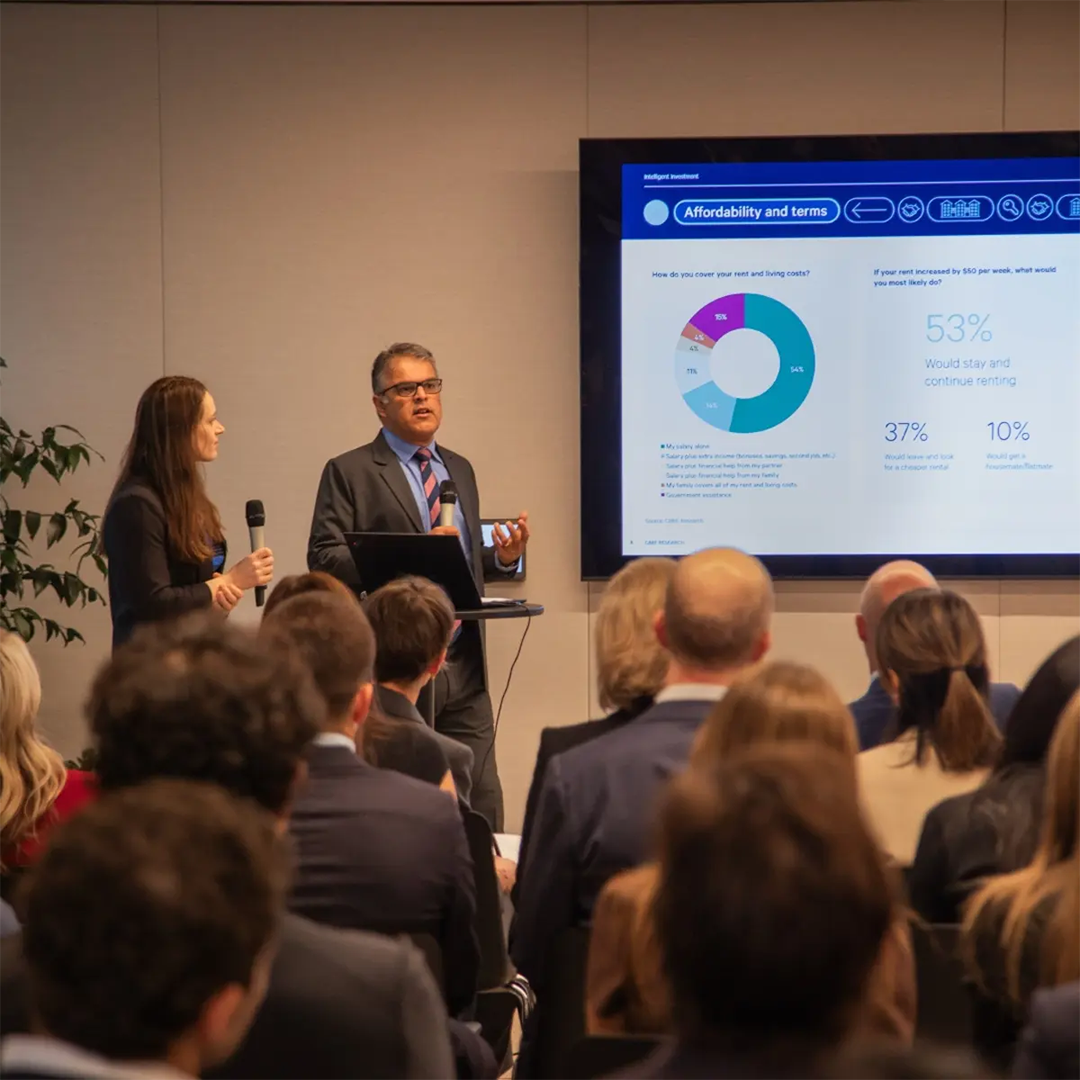
Hello, and welcome to Talking Property with CBRE. I'm Kathryn House, your podcast host, and today we'll be delving into Australia's housing supply challenge. In a collaboration with REA Group, CBRE recently published new renter research, showing that Australians are renting for longer, under more pressure, and making deeper tradeoffs than ever before. Meanwhile, capital is looking at opportunities to service this renter cohort through products like build to rent, purpose-built student accommodation, co-living, social and affordable housing, and land lease. But this capital is selective, highly mobile, and Australia's housing market remains chronically undersupplied, an issue that was the topic du jour at last month's Property Council of Australia National Housing Solutions Summit. So today we're asking, if rental demand is strong and capital is available, what's stopping more Australian homes from being built? And where are the emerging opportunities?
Carolyn Viney
Telling developers that they can only develop apartments that are 150 square metres and more, that the cohort of people in our communities who can actually afford to rent or buy that is a really, really small proportion of people. Is that really a way of saying we only want really wealthy people to live here? And in the middle of a housing crisis, what kind of message is that?
Kathryn House
That's Carolyn Viney, the CEO of Assemble, an end-to-end housing company which enables Australia's superannuation funds and other large institutional groups to invest in affordable housing. Majority owned by Australian Super and HESTA, Assemble has an ambition to deliver 17,000 homes nationally by 2034, spanning a mix of market rate, affordable, and social housing.
Anne Flaherty
When it comes to where renters are looking to live, overwhelmingly, it's your CBD, city fringe markets where we're not really seeing that more affordable product being built. The fact that we're not really delivering enough new supply in these key locations where renter demand is growing is really quite concerning for the outlook of our cities.
Kathryn House
That's Anne Flaherty, senior economist at REA Group, who specialises in property trends in both the residential and commercial markets.
Andrew Purdon
We've got a pattern at the moment where apartment projects in particular are being put on pause or deferred because of uncertainty around construction costs or because the cost versus value equation is out of kilter at the moment in a lot of markets. So if we go in that direction, yeah, we're going to have more urban sprawl, more reliance on cars, these sorts of issues, which I I don't think is really a step forward.
Kathryn House
And that's Andrew Purdon, CBRE's head of living sectors, capital markets in Pacific. I hope you enjoy our conversation. So, Carolyn, welcome to Talking Property. You were a panelist with Andrew at last week's Property Council Housing Summit, and I thought this was a great opportunity to explore some of the issues that were raised in a little more detail.
Carolyn Viney
Great to be with you, Kathryn, and really pleased to be contributing to this conversation that's one of the most important ones that we're having right across the country.
Kathryn House
Absolutely. And, Anne, great to have you join us also to explore some of the insights from the new Australian Renters Survey.
Anne Flaherty
Thanks for having me as well. Absolute pleasure to contribute.
Kathryn House
And, Andrew, good to have you back on the show. There's always a lot of listener interest in what's happening in the living sector.
Andrew Purdon
Yeah. Hi, Kathryn. Great to be here again. And, you're right. Housing's always a hot topic in media and politics, so looking forward to getting into it.
Kathryn House
So as we jump in, Anne can you give us a quick snapshot of the headlines from the Australian Renter Survey? One of the data points that really stood out to me was that nearly a quarter of renters plan to stay put for five years or more with a growing number of households viewing renting as a long-term solution.
Anne Flaherty
Yeah. And, look, it was a surprise to me as well. I think that we often think of renting as a shorter-term solution or something that you do, you know, prior to buying. But one thing that really stood out in this research is that people plan to stay in their rentals for a long time. So there were more people who were planning to stay for five or more years in their existing rental compared to people who wanted to stay less than this. There's still, of course, a pretty sizable proportion around a third who are a bit unsure about how long they want to spend in their rental property, but that five plus years was really quite surprising.
Kathryn House
I think one of the other surprising things for me was around the fact that Australians earning more than a $100,000 a year are being forced into share housing as the cost of living impacts this ability to save for a deposit. How is that reshaping the market, do you think?
Anne Flaherty
Look. I think it's absolutely reshaping what we think about share housing and who does it. I think in the past, we thought of it as something that you do when you're a uni student. Maybe you're a couple of years into your career, but increasingly we're seeing people in share houses later in life. And actually, our research shows that the 55+ age categories is the fastest growing category for those looking to rent in a share home. And affordability is the primary reason here because, when we look about why people live in a share home, overwhelmingly, they state that it's because they can't afford to live alone.
Kathryn House
So it's interesting on that affordability piece and a great segue to you, Carolyn. Do we need to rethink the housing product types that are being developed in Australia? I was really interested in comments you made at the summit about the need to be delivering housing of all types at the affordability people need, so potentially more studios compared to one bedrooms. And Stephen Gaitanos from The Living Company made a really similar point about younger people being more comfortable to rent in smaller places if they're well designed. So are we looking at this the wrong way, Carolyn?
Carolyn Viney
I don't think we're looking at it the wrong way, but I do think these megatrends, and they are megatrends, and they're playing out kind of across the world, not just in Australia, where we're seeing big cohorts of people, as Anne touched on, who are going to rent and rent for longer. So that mind shift of we're not just talking about young people before they buy a home. We're talking about people who might actually rent for 20 and 30 years or maybe forever. The expectations they have from their rental accommodation are understandably different when they're thinking that this isn't a transition to something else. This is where they're going to be. So the affordability dimension of that is an important one, and we're seeing, at least in our experience in the market, we're seeing a lot of sensitivity around price point. So the two-bedroom apartment that you could rent five years ago for six hundred bucks a month, if that's now $800 a month, then the decision to do a two bedroom as a single and have that spare room for someone to occasionally stay in or maybe use it as your work from home space, that single might decide, actually, the $600 a month one bedroom is fine for me because in my building, I have a coworking space, which is where I can have that desk and do the work. And similar, families and people who are sharing in a two bedroom, two bathroom apartment, the price impost of that second bathroom is sort of resulting in some people saying, well, actually, we absolutely need the two bedrooms, but we're happy to share a bathroom and save $100 a week or $50 a week on that. So there's all sorts of different ways in which the data is telling us that people are much more price conscious than they've ever been before, and the product that we designed for people, as a result of that, needs to be really responsive to that. The opportunity, I think, for the private sector people who are delivering these homes to play a really close game with the government town planners who need to keep abreast of what are those trends telling us about where the demand is, I think, is really important because affordability and access to housing is kinda trumping everything else.
Kathryn House
Yeah. You said something really interesting, Carolyn, at this summit, and it was about one Sydney LGA, which was mandating the size of apartments, and that that was a little, potentially mind boggling.
Carolyn Viney
Well, it just feels like it's completely tone deaf to the fact that telling developers that they can only develop apartments that are 150 square metres and more, that the cohort of people in our communities who can actually afford to rent or buy that is a really, really small proportion of people, which is why I said at the Summit, is that really a way of saying we only want really wealthy people to live here? And in the middle of a housing crisis, what kind of message is that?
Kathryn House
Yes. And it was very interesting, Anne, Carolyn mentioned, I guess, people making tradeoffs, and that came through really clearly in the renter report. Can you tell us some of the data that you're seeing around the tradeoffs people are now making?
Anne Flaherty
Yeah. Absolutely. Like, if we go back to the pandemic when vacancies were skyrocketing, we actually saw some really different trends. So a lot of people were searching for larger homes to rent. They were also including a lot of keywords in their rent searches. What we're now clearly seeing is that the total number of people including keywords in their searches has decreased, and people are absolutely compromising on the size of the property. So the two primary things that determine whether or not someone will rent a property are the price point and the location. And whether that means foregoing that extra study space or maybe that spare bedroom, we're seeing that people often don't have a choice but to make compromises, and the type of properties is really the big one here.
Kathryn House
Yes. So, Andrew, the growth in Australian renters has been a 30-year trend in Australia and one that is now accelerating. How is this ongoing shift shaping the way investors are viewing Australia's Living sector? I've heard you speak about the fact that with housing demand diversifying, each housing type requires different capital structures and delivery approaches.
Andrew Purdon
That's right. I'll borrow Carolyn's comment about megatrends, you know, that the increase in the percentage and volume of renters in Australia is a 30-year trend. So that's undoubtedly a megatrend. But what we're seeing now is investors and platforms, you know, really segmenting the renter cohort. And, you know, Carolyn's business is a great example operating across various different segments, which I'm sure we'll come back to from affordable through to build to sell, through to build to rent, single family housing. So, yeah, the capital is looking at the megatrends, the demographics, what do the customers want, and trying to align a strategy for operating the rental housing space primarily. You know, what is the type of rental housing that the individual investor believes in most? And that also then translates to the type of housing that we're talking about. So it's what are the customer needs? What's the type of product that they need? And where do they need it? So it's important to think about the dominance of the city centres, the inner ring markets for renter demand as well across Sydney, Melbourne, Brisbane. You know, in the inner ring areas, about 50% of people actually rent. And in some specific neighbourhoods, which we we've been very active in across the East Coast cities, you know, the percentage of renters can actually be as high as 70% of people in those neighborhoods are renters. So when we're aligning planning policy, capital flows, typologies of construction, we've gotta think about the needs of people today and then the needs of people as the country develops.
Kathryn House
Well, it's a good segue back to Carolyn, and I and I did mean to ask you. Can you tell us a little more about the Assemble model? And I think it revolves a lot around delivering both returns and social outcomes at scale.
Carolyn Viney
Yeah. I mean, Assemble is an end-to-end housing company, but with investment at its core. And the idea that institutional investors have not really had a lot of opportunity to invest in housing in Australia, but for the size of the demand that we're seeing for affordably priced rental housing, the critical need for those large institutional capital providers to play in this space is really what Assemble was designed for. So well before my time, Assemble was conceived in 2016 as a way of enabling superannuation funds and other large, value aligned institutional investors to invest in housing in Australia. And everything we do here is really focused on scale and replicability, but in that low- and middle-income cohort with that focus. So if it's sort of outside of those things, then there's other people who do that really well. But for the piece that we saw that was missing, it was who wants to deliver affordable housing at scale. And by extension of that, the scalability piece means you need big capital partners to be able to play a role. So we don't do everything. We're not ever gonna be everything to everyone. We're not a solution to the housing crisis, but we think we're playing an important role in a piece of the market that's traditionally been underserved.
Kathryn House
It's interesting that you mention superannuation fund money, which is a big backer of your model. But there was so much talk at the Summit about the local superannuation funds still not playing a big part in this market and investing more offshore. Are we starting to see any shift in that regard?
Carolyn Viney
I really think we are. Like, I mean, I think the history of rental housing in Australia, bringing it all together into a scalable, programmatic deployment kind of methodology is, I think, what is critical to attracting any kind of institutional capital. So whether it's a large pension fund from Asia or the North American kind of market or whether it's a local one like Aussie Super and HESTA, who we obviously do a lot of work with, they're not interested in, I'll do a project here, and then next year, I might do a project there. They're all interested in a long-term programmatic deployment into a particular strategy, and Andrew touched on it before. You know, they're generally not saying, I'll just do everything in every kind of housing. They wanna know whether you're doing student accommodation or whether you're doing affordable build to rent or whether you're doing build to sell. And their strategic focus and their investment thesis to play in a particular market is tied to one of those things and then finding a partner and a methodology where they can do that over the medium to long term. They do a lot of research and a lot of due diligence, and it needs to be scalable in order to justify the investment that they've made in that strategy. So for us, with AustralianSuper and Hesta and their partnership at an asset level and their ownership of the platform at a corporate level is underpinned by a commitment that we've made to originate and deliver 17,000 homes by 2034, and as part of that, put $15 billion dollars to work. And, again, that's the strategy and the program that they've bought into, and that's what we're doing. I think if we were having the conversation about we're just doing, like, this project in Melbourne next year, do you want to fund that? Like, they are the wrong source of capital for that kind of opportunity. There's other capital that's suitable for that, but the big conversation about where are the institutional players in this space is about giving them longevity to see through a program.
Kathryn House
Andrew, on that capital front, why aren't we seeing capital flowing faster, do you think? At the Summit, Anouk Darling talked about this being a friction problem, not a fundamentals problem. And I was really interested in Campbell Hanan's comment that capital doesn't like uncertainty and doesn't protest, but goes elsewhere. What are your thoughts?
Andrew Purdon
Yeah. We've gotta be respectful of the environment we're in at the moment. So we're we're in an inflationary environment. We've had an increase in the cash rate yesterday, and and all forecasters are saying we've got more to come in 2026. And what history shows us, and it's not an Australian thing, it's it's a global thing, that when we're in an inflationary environment, capital deployment into real estate does slow down. Transaction volumes come off. So that's the first point. I think the other point is that as Carolyn described, the majority of the activity in the Living sectors is development orientated today, and there is an elevated level of risk at the moment around construction inflation. So we have seen a bit of a pattern, and I think Anne will probably touch on this in terms of the forward look for apartment supply. We've got a pattern at the moment where apartment projects in particular are being put on pause or deferred because of uncertainty around construction costs or because the cost versus value equation is out of kilter at the moment in a lot of markets. So Carolyn's comments around, you know, the mid market and affordable end of the market, that is without doubt where the highest need is, but it's also the most challenging environment to develop in at the moment because of the the cost base that we're working with. And Campbell's comments around certainty is absolutely right. Now that there is some concern at federal and state level around uncertainty of taxation. We've seen some taxes come in for build to rent and, overseas surcharges on stamp duties and so forth. So the government, I think, at all levels, needs to really think carefully about how we attract sufficient capital, domestic and offshore, to actually fulfill the needs of the country to create housing because, in my opinion, there isn't enough capital in Australia alone to deliver the amount of supply that we need. So, yeah, the flow is a bit slower than we'd like, but we've got to recognise some of that is just cyclical. The other character, of course, is that we are seeing investors selecting those segments that we talked about before also depending on the tax settings within those segments. So we're seeing a bit of a pattern of some investors moving from build to rent towards student accom because they can still access the same fundamentals, undersupplied markets, very steady and growing demand, but with less taxation than other segments of living. So it all kind of gets combined into decision making for investors.
Kathryn House
Yes. It's an interesting conversation around, you know, at the Summit, people were repeatedly saying there's no 'silver bullet', and, you know, how much is policy and tax settings holding supply back. Carolyn, if there's one thing that you could remove tomorrow as part of this friction problem to shift the dial, what would it be?
Carolyn Viney
Look. I think it's the complexity that we've added to how homes are delivered. The idea that building a home, whether it's an apartment or a detached dwelling out in the suburbs, takes longer than it did twenty years ago, notwithstanding all the technological advancement that we've had is kind of really hard to get your head around. That obviously adds cost. The fact that we've got Master Builders saying that people don't really wanna be a house builder in Australia, it's just so complicated. There's so many levels of regulation. At the conference, we talked about the National Building Code and just how long it is, 1200 pages, how does a small business, and the majority of people delivering houses in Australia are actually small businesses, carpenters and qualified master builders, get their head around 1200 pages, and it changes every couple of years just to kind of keep them on their toes.
Kathryn House
With different state and territory variances as well.
Carolyn Viney
Yeah. Make it even more spicy. Fantastic. So, yeah, I think whilst we absolutely need well designed, sustainable, quality homes, again, coming back to that language of trade off, like, just exactly how much prescription and discretionary outcomes are we loading into something that could actually be much simpler and much more scalable as a result? So, yeah, for mine, if we could just look at from cradle to grave, what are all the things that adds up to that ridiculous time period associated with building a single house, and how much of it do we need? And then how is it coordinated across government, including at the Commonwealth, the state, and the local government level? And how do we just make it easier treating it like it is an issue of national importance. It doesn't feel like we're getting quite the cut through on that, albeit I know that there is good work happening under the Accord to bring some of those themes together, but it sort of feels like it's still in a sort of talking nicely conversation around, really, what are we gonna do to rip the Band-Aid off and kinda get on with it.
Kathryn House
Talking about the Accord, most people agree that target of developing 1.2 million new homes by 2029 is pretty unlikely at the moment. And, Andrew, I know you have some views on how that target should potentially be reset in the future to better take into account the nuances of supply and demand. Can you talk us through your thoughts there?
Andrew Purdon
Yeah. Well, look, I'm very pleased that there's a national target. I think it's really important to be aspirational and to drive towards something which is, you know, a committed goal. But back to my comments before about the distribution of demand and what the country needs in different parts of every city, I think that the Accord could be more nuanced around recognising the need for the continuum, you know, whether it be what social and affordable is embedded in the Accord. So that's really important as a key piece of the puzzle. But, you know, PBSA should be in there because PBSA takes pressure out of the private rental markets in the cities where the unis are located. We should recognize within the the accord the megatrend of more renters and where that demand for renters is is hottest, which is in the city centres. So really in my opinion we should have a new rental home target embedded within the Accord. And then of course we've got all the way through to master plan communities, single family housing rentals, you know, which are also a really important part of the overall need of the country. I think my one of the areas that surprised me and shocked me a little bit from the Summit was some analysis that was done on where the supply is actually going to come from between '26 and '29 and it was very greenfield orientated supply because of the cost impediment of building apartments at the moment. So that that's quite different to the ambition of the country to densify our cities around public transport infrastructure and sustainable employment etcetera. If we go in that direction, yeah, we're gonna have more urban sprawl, more reliance on cars, these sorts of issues, which I don't think is really a step forward. It's a response to the economics we're in at the moment and the inflationary environment, but it doesn't take us forward with our cities, in my opinion. Anne, I don't know if you've got a view on the forward look for supply, but it's, you know, I'm sure you will have looked to this data as well.
Anne Flaherty
Yeah. Look. From our end, we completely are seeing that the vast majority of new housing development, it's greenfield that's further and further away. We've actually been doing some research looking at new apartment supply. And because the cost per square metre, the complexity of building apartments is so high, what we're seeing is that on realestate.com, well over half of new apartment supply is being priced at that $1.5 million dollar or above level. And we also know from our own research that only around 12% of buyer budgets looking to buy a new apartment are sitting at that level. So there's a massive mismatch between the apartment stock that is being built in those more attractive, appealing locations. But the question is, who is going to buy those? So I think that even with the current estimates of the undershoot for the Housing Accord, the reality is that a lot of these projects that are approved, that are assumed that are going to be built, a lot of them probably are going to end up shelved or the delivery of them is going to be very, very delayed.
Kathryn House
And it was interesting that similar data coming through on the renter front as well if we're talking about the greenfields subject because the survey, I guess, rental searches are showing that renters aren't searching for outer suburban. They're more still searching for inner suburban homes.
Anne Flaherty
Yeah. That's exactly right. So, predominantly, it's your owner occupiers, especially first home buyers who are looking to buy out in those newly developed greenfields areas. But when it comes to where renters are looking to live, overwhelmingly, it's your CBD, city fringe markets where we're not really seeing that more affordable product being built. Remember as well, in particular, a lot of student suburbs, these aren't people who are, you know, looking to spend a thousand dollars per week to rent somewhere. They're people who are more budget conscious. So the fact that we're not really delivering enough new supply in these key locations where rent to demand is growing, is really quite concerning for the outlook of our cities.
Kathryn House
Carolyn, one of the other things I wanted to chat to you about which came out of the Summit was about mixed tenure housing models. Give us your thoughts on the importance of mixed tenure.
Carolyn Viney
We are long on mixed tenure at Assemble that's grounded in sort of global best practice and research that we have in markets around the world where that's been embraced earlier than Australia. Typically, what we've done, and I'm thinking about as a Melbournian, what we call the Housing Commission flats that are in the process of being rebuilt here in Melbourne where we put all the social homes in big pockets in certain suburbs and whole buildings were full of social tenants as opposed to mixed tenure, which says that social, affordable and market tenants should all be blended together, if not in a building then in a precinct. And, again, sort of the research supports the fundamental functionality of that model. And it is much more in line with the way normal suburbs evolve. Like, we don't say only these people live there. In a normal suburb, we've got little houses and big houses and north facing houses and south facing houses and things that are close to the train station and things that are far away from the train station. You know, the idea that it's a blend and that people living their normal lives have got their own apartment near someone else's apartment and they all get on together, that's what mixed tenure really is. And I don't think it's fundamentally different than the way great cities have evolved over time. And then our first asset, which is a mixed tenure asset delivered for HESTA late last year. It's 362 homes. Twenty five percent of them are social, 50% of them are affordable, and remaining 25% are market. We have had no issues leasing up that building, and we don't get resident complaints. Like, they're just people living their lives, but they happen to be on different income levels. And it's going well. And if that's a proof point for sort of what comes next, then we're intending to do a lot of that.
Kathryn House
How are investors viewing mixed tenure, Andrew?
Andrew Purdon
Pretty positively. I mean, the MIT changes for build to rent include to access a concessionary rate of tax you have to include a minimum of 10% affordable within the building. That's defined as, a discounted market rent. So I think we're also gonna distinguish between the different types of affordable and social housing because they do come with different character of customer demand, you know, some needs. But in the build to rent example, it's a discount market rent based upon an eligibility criteria for income, household income of the residents. And that works really, really well because you've got people living in the building alongside market rent. You know, people with really good jobs that just happen to be a slightly lower paid job. We actually sold a building last week in Brisbane that is part of the Queensland Pilot Scheme, which is an an affordable housing built to rent scheme as well, where we we sold 366 apartments for Frasers as the developer, and 40% of that building is actually for affordable housing as well. Same thing, discount market rent. I was speaking to the property manager and, the building's just finished and that they're 20% leased after a month. So it proves up the demand for this stuff. And, actually, in that instance, it was another domestic investor that acquired it in the form of Barings as a manager with Aware Super behind them. So really, really positive endorsement of mixed tenure, albeit all rental tenure. I think it is also a bit more nuanced, Carolyn, if you're trying to rent some apartments or houses and then sell some as well. You know, the the the interplay of the different uses can get more complex there for funding, for example.
Carolyn Viney
Yeah. I mean, there's we don't blame build to sell and build to rent into one asset. Like, they're separate propositions for us partly because the capital who's attracted to those is probably different as opposed to trying to find someone who wants to do everything. But, you know, there are good case studies, and I'm thinking about the MAB project at Preson Crossing, where build to sell and social housing was in the same precinct, which is sort of the lived example of social tenants who are renting, and then in that same precinct, apartments being sold to normal mum and dad purchasers. So yeah. So it is possible. I I do think one of the things about mixed tenure is sort of the additional consideration you put into how you manage these assets, not because it's specifically complicated, but that idea of just having the way a normal rental building might work where there's lots and lots of owners, trying to coordinate that, I think, is really difficult. And the build to rent, single ownership, everyone under one roof is probably the game changer that really enables mixed tenure. And in some ways, what we're talking about today is this kind of virtual circle of changes. Institutional ownership means single ownership means you can curate the community, means you can sort of step in and manage things as and when you need to as opposed to trying to do it through a body corporate where there's a hundred kind of voices you might need to make a decision on something. There's just some clear advantages that build to rent has over that segregation or desegregation of housing that we've seen previously.
Kathryn Houes
So we've talked about supply. We've talked about different housing models. Maybe a few rapid-fire questions for each of you to close. But firstly, say, which housing model do you think has the potential to scale fastest in Australia in the short to medium term? Carolyn.
Carolyn Viney
Build to rent because in a high interest rate, high cost of living environment, the idea of people making big life decisions about saving a deposit and buying a home, I just think we'll, unfortunately, continue to see some tentativeness from the market for build to sell.
Kathryn House
Anne, what are your thoughts?
Anne Flaherty
Gonna double down on build to rent. I think that particularly in the current environment, we're seeing increasing nerves around investing and buying, uncertainty around interest rate outcomes. So I think build to rent is actually well positioned to really, at scale, help to deliver new housing.
Kathryn House
I think I might know the answer already, Andrew, but what are your thoughts?
Andrew Purdon
I’m going to go with a subset of build to rent, actually, because one of the key findings of Anne's research was the dramatic increase in single person households within our cities. So I'm gonna go co-living, studios, built to rent, a subset of built to rent.
Kathryn House
Second question to close us out. Carolyn, what do you think the biggest risk for the sector is in the next 12 months?
Carolyn Viney
I think the biggest risk for housing, if we're talking about that as a sector, is a failure to, I'll call it double down, taking Anne's language, to double down on the good progress that's been made to date in trying to shift the dial, remove some of the things that are getting in the way of housing, and sort of thinking the job's done. I think we need to just keep at this for the next five or 10 years until we've properly fixed it.
Kathryn House
Anne, what are your thoughts?
Anne Flaherty
Look. I I it's hard to pick just one thing. I think the interest rate environment, the high building cost environment, we're already seeing signs that building costs have increased pretty dramatically off the back of higher transport costs, war in Iran, etcetera. I also think, though, uncertainty around what you know, we're gonna see very shortly what's gonna happen with policies around investors. And I think that at the moment, private investors supply the vast majority of rental properties in this country. And to dramatically reduce demand from investors is absolutely down the track going to have dire consequences for, rental supply.
Kathryn House
And, Andrew, to close us out, what are your thoughts?
Andrew Purdon
I'm just gonna focus on the cost inflation risk at the moment because we actually had quite a lot of construction cost inflation coming through the market pre the Middle East conflict, and that's now been accelerated. So, yeah, given the uncertainty in the Middle East, we're all hoping, aren't we, that it's gonna settle down as quickly as possible. But I think there's always a lag with construction, cost inflation. I'm just concerned around where it could get to towards the back end of this year and then the knock-on effect for, construction starts basically in housing.
Kathryn House
Well, I think there are so many more areas that we could have talked about today. There's so much that is shaping the supply of housing in this country. But, thank you so much, Carolyn, for joining. I really appreciate your time today.
Carolyn Viney
Great.
Kathryn House
And thanks, Andrew. I'm sure I'll have you back on in the near future.
Andrew Purdon
You're welcome, Kathryn. Great to chat as always.
Kathryn House
And I really enjoyed the research that you published on the Australian Renter Market, so we will include a link to that in the show notes today if people want to check that out.
Anne Flaherty
Great. And thank you for having me for today.
Kathryn House
So CBRE's renter research tells us that demand is deep and long term. Capital is telling us it's interested but selective. And from today's discussion, there is both friction and opportunity as well as some risks in the Australian housing sector in what's an increasingly renter-led market. To our listeners, thanks for joining this latest episode of Talking Property with CBRE. If you enjoyed the show, we'd love for you to rate or review the podcast, which will help other people find us. Until next time.