Article | Intelligent Investment
Business Insights | AI’s impact on the Australian way of life depends on one asset class
Generative AI is being used in courtrooms to football fields, but its growing influence on daily life drastically depends on the data centres required to power it.
October 22, 2025
Learn more about data centres
Click HereWhile the profession’s future is difficult to predict, there’s been evidence of a growing trend: 84 reported cases of generative AI use in Australian courts since ChatGPT launched in late 2022.
These academic findings via The Conversation revealed that more than three-quarters of those cases involved people representing themselves, known as “self-represented litigants”.
“Those people - who sometimes have valid legal claims - are increasingly turning to different generative AI tools to help on everything from property and will disputes, to employment, bankruptcy, defamation, and migration cases,” explains Michael Legg, Professor of Law at UNSW Sydney.
It's a theme which isn’t too dissimilar to what’s happening over in the NRL - one of Australia’s most popular sports – which announced that it would begin using artificial intelligence for the first time to compile its 2026 draw.
Meanwhile, at the fiscal end of the spectrum, there’s a growing adoption of AI amongst the payments industry. Financial services are using machine learning to predict cash flow, detect fraud and analyse credit scores while fostering authentic emotional connections within the payment process – the latter achieved by predicting a customer’s needs based on their purchasing patterns.
They’re all novel ways AI is currently being pioneered into the norms and necessities of daily life, but it raises an even more important question: How is this rapid adoption across diverse industries being supported?
Data centres is the answer.
Rise of Australian data centres
Data centres form the backbone of today’s most ambitious advances in AI.CBRE’s latest research reveals how rapid AI adoption, along with hyperscale cloud growth and facility upgrades, is driving increased data centre demand in Australia. As a result, it’s a sector that’s become one of the most attractive markets for investors globally.
“Australia’s investment appeal is underpinned by yield stability, long lease terms, and strong credit covenants, which together deliver attractive risk-adjusted returns,” explains Sass Jalili, CBRE’s Head of Industrial & Logistics, Data Centre Research, Australia.
“Australia’s data centre sector has undergone significant transformation in recent years, evolving from what was once considered a niche infrastructure play to a highly sought-after real estate asset at the forefront of tech innovation.”
CBRE’s latest sector report focusing on why Australia remains one of the most attractive data centre markets globally, forecasts that the country’s live data centre capacity is expected to increase from approximately 1.4GW in 2025 to circa-1.8GW within three years. This figure still falls short of projected demand, resulting in an estimated supply gap of 0.7 to 1.7GW by 2028.
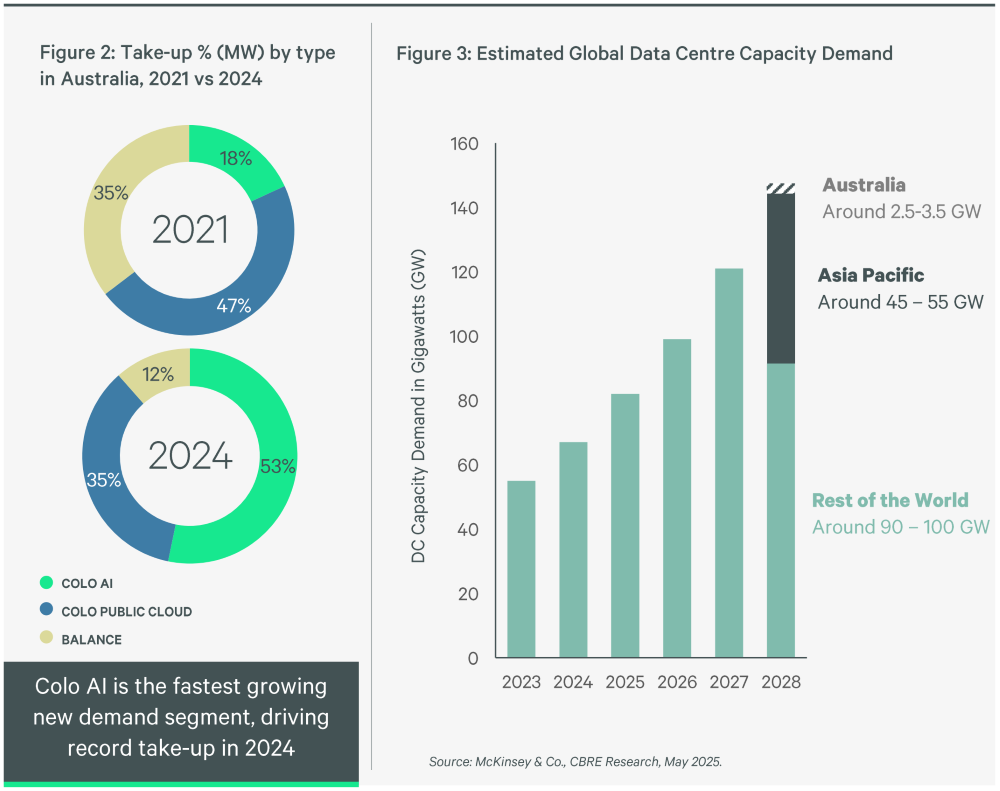
Estimated global data centre capacity demand
Understanding the investment potential
Australia’s secure energy grid, robust regulatory framework and stable political environment provides investors with long-term certainty in an increasingly competitive Asia Pacific landscape.“Australia combines rising AI-driven demand, resilient pricing, and a globally competitive cost base, making it one of the most attractive markets for data centre investment,” says Sass. “Sydney and Melbourne have emerged as core hubs within the Asia Pacific network, attracting both domestic and offshore capital.”
Based on the pipeline of committed projects, CBRE forecasts Australia’s investible universe for data centres will grow by around 50% in the next four years to total circa AUD $46 billion.
Investment in data centres has continued to build momentum in recent years, with institutional capital flows continuing to strengthen Australia's investment case, according to CBRE’s Pacific Data Centres Capital Markets Director, Darcy Frawley.
“Institutional capital inflows are accelerating and investor confidence in Australia’s data centre sector is expected to continue to strengthen over the remainder of the decade. Low vacancy rates and solid underlying market fundamentals underpinned by AI and cloud growth are set to provide a strong platform for investors to scale within the Australian market.”
Darcy explains that alongside hyperscalers, the rise in AI has led to the emergence of a fast-growing class of ‘NeoCloud’ customers who are beginning to drive colocation demand.
“NeoCloud are AI-native and digital-native companies, that scale rapidly but lease large blocks of colocation capacity rather than building their own hyperscale campuses.
“Australia's data centre supply pipeline is heavily pre-committed; vacancy now sits at just 12%. These supply pressures, combined with longer lead times due to material shortages are expected to continue to place upward pressure on Colo rental rates. At the same time, the size of individual lease commitments is increasing, as hyperscalers and enterprises secure larger, longer-term blocks of capacity in anticipation of future demand,” he adds.
Understanding the challenges
As with any investment class, knowing the challenges of Australian data centres is critical. CBRE’s report highlights these four key challenges for data centre growth and development:
- Access to adequate power supply: The surge in demand for data centre development in Australia has intensified pressure on the national power grid, particularly in Sydney and Melbourne
- Elevated construction costs: Construction costs for data centres in Australia remain among the highest in Asia Pacific
- Tightening site availability: The availability of suitable development sites in Sydney and Melbourne is becoming limited
- AI-readiness gap: Much of Australia’s existing data centre stock was designed prior to the AI and GPU-computing boom. This means they often lack the power density, cooling systems and structural specifications needed to support high-performance AI workloads
Learn more about the strengths and intricacies driving Australia’s data centre market in our latest Why Australia for Data Centres report.
Or listen to our leader’s take on AI’s impact on the real estate sector in the latest Talking Property: House View podcast.
Get in Touch
Sass Jalili
Head of Industrial & Logistics, Data Centre Research Australia and Director of NSW Research

Darcy Frawley
Director, Capital Markets, Data Centres, Pacific
